

Cohere released Rerank 4 in two variants – Rerank 4 Pro and Rerank 4 Fast – so we plugged both into our benchmark to see: did they actually improve over v3.5, and how do they compare to each other?
The results weren’t small bumps. Both are clear upgrades, but with different trade-offs.
Cohere went from mid-pack to #2
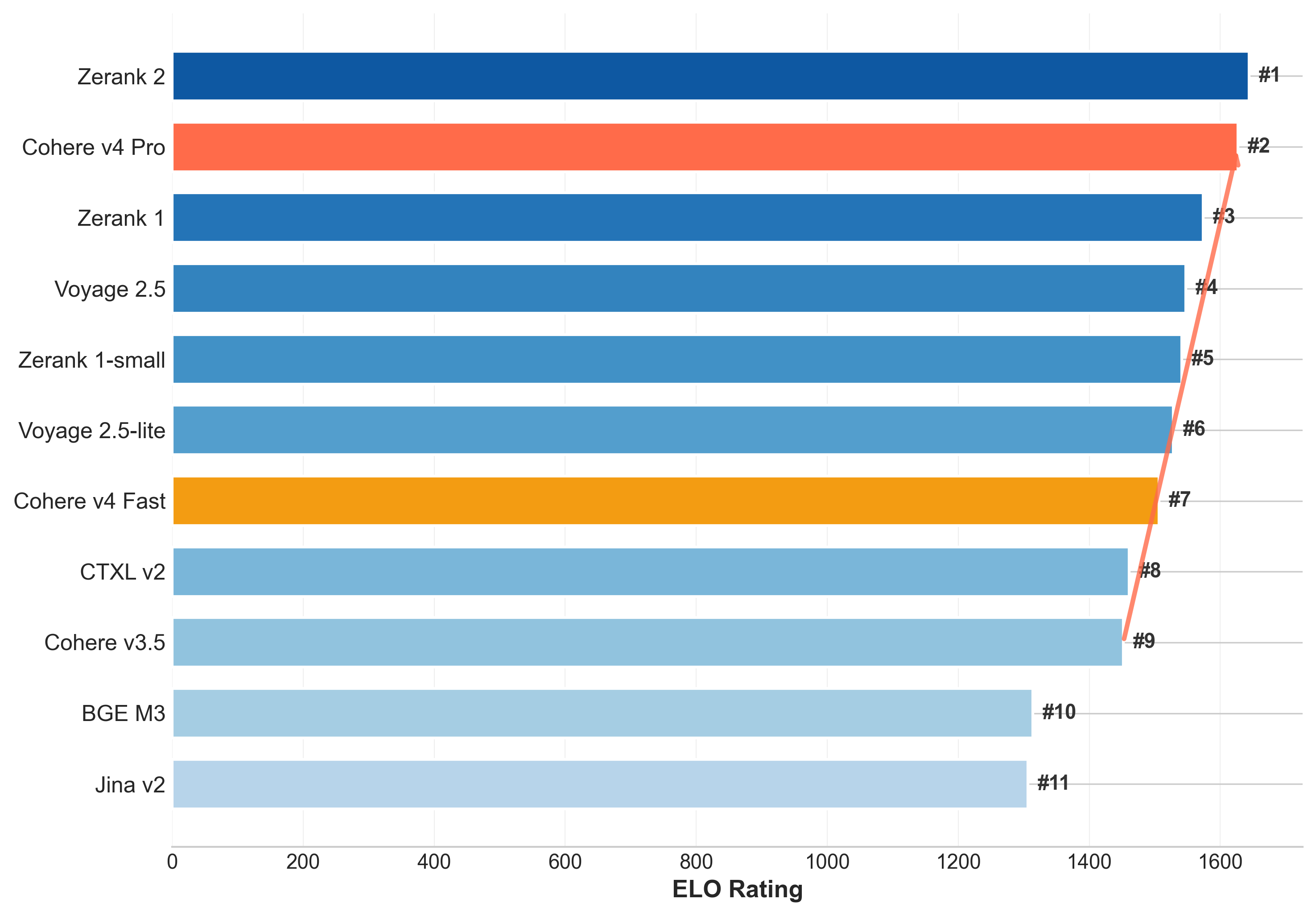
Cohere’s previous reranker (v3.5) sat in the lower half of the leaderboard, with an ELO around 1457.
- Rerank 4 Pro reaches 1627 ELO (#2 overall) just below zerank-2. For a single version upgrade, that’s a big shift.
- Rerank 4 Fast lands at 1506 ELO (#7) – still a meaningful improvement over v3.5 (+54 ELO), but clearly below Pro.
So Rerank 4 isn’t one model; it’s two different points on the quality–latency curve.
Patterns That Explain The Shift
- Biggest gains on “enterprise” workloads: the largest improvements show up on business- and finance-style tasks, where Rerank 4 Pro gains a bit over +400 ELO vs v3.5, and Rerank 4 Fast gains around +300 ELO (business) and +140 ELO (finance).
- Pro has no regressions; Fast is more mixed: Rerank 4 Pro beats v3.5 on all 6 datasets, with every bar in the improvement plot above zero. Rerank 4 Fast improves on enterprise and entity-heavy workloads, but gives up quality on some argumentation and web-style QA datasets.
- Latency is the main trade-off: Rerank 4 Pro is ~60% slower than zerank-2 and sits around the same speed as Voyage 2.5. Rerank 4 Fast is noticeably quicker than Pro, and both variants stay under a second on average.
Let’s look at each finding in detail.
The big gains are on business and finance-style content
The overall ELO jump is nice, but the more interesting part is where the gains come from.
When we split the results by workload type, the biggest improvements show up on:
- long, dense business documents
- finance and economics question answering
On those tasks, Rerank 4 Pro scores roughly one-third higher than v3.5 in ELO terms. That’s a large gap for models that are running on identical input.
Rerank 4 Fast also improves on these workloads. The gains are smaller than Pro’s, but still clearly ahead of v3.5, especially on business reports and financial Q&A.
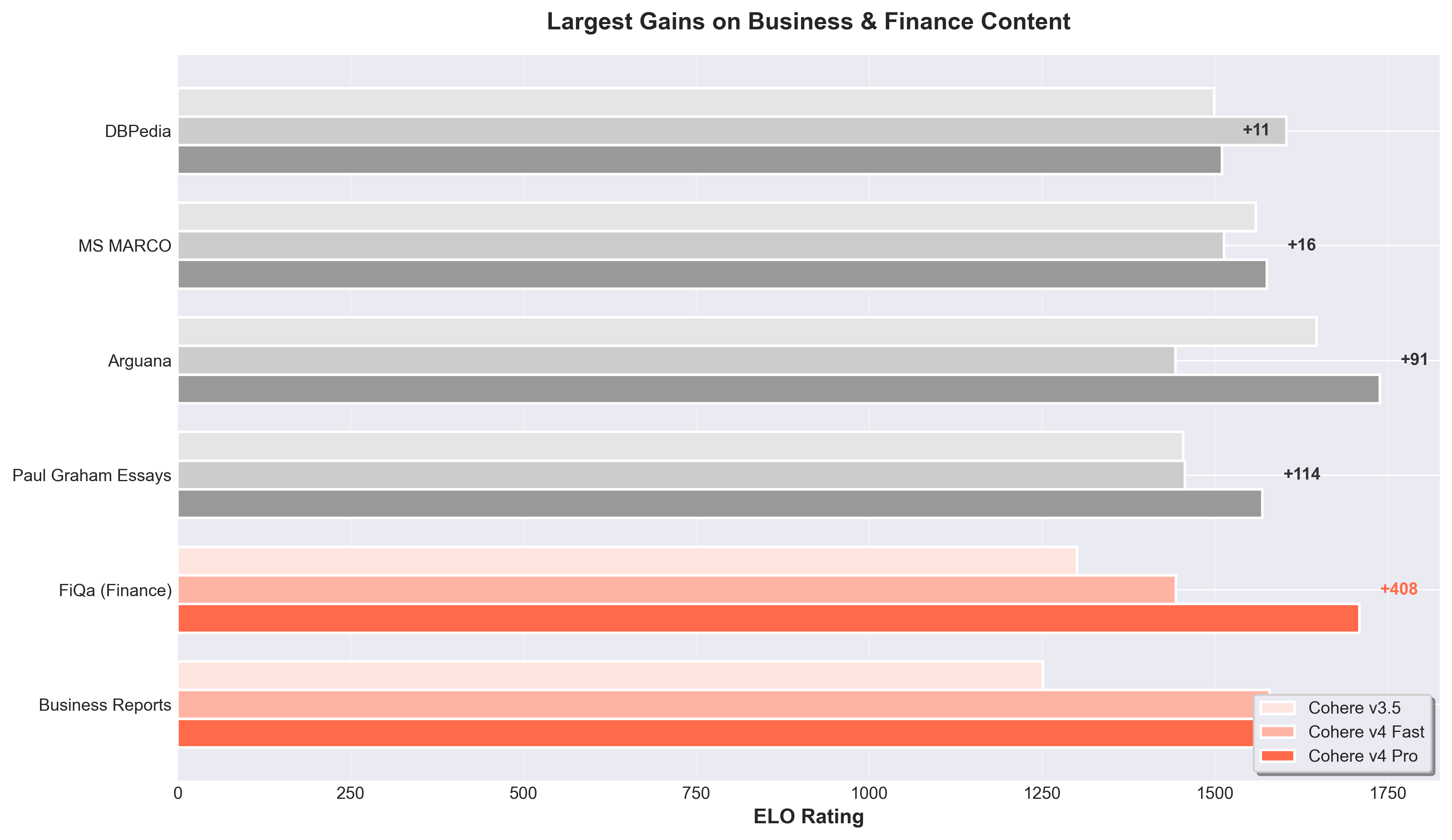
This lines up well with how enterprise RAG systems actually look in practice: long internal reports, slide decks, memos, filings, and specialised vocabulary. In that environment, getting the “right” two or three passages into the context window matters more than shaving off a couple of milliseconds.
So if your corpus leans towards board reports, financial notes, and internal strategy docs instead of short web snippets, Rerank 4 Pro is not just marginally better – it’s operating in a different range than v3.5, with Rerank 4 Fast sitting in between the two.
Pro is consistent, Fast makes trade-offs
Another thing we checked for was regressions.
A common pattern with new models is: big gains on one dataset, small but real drops on another. That forces you into routing logic or model mixing to avoid the weak spots.
Rerank 4 Pro doesn’t show that pattern. Across all six workloads we test – argumentation, business reports, finance, long-form narrative, web-style QA, and more entity-heavy queries – Pro is ahead of v3.5.
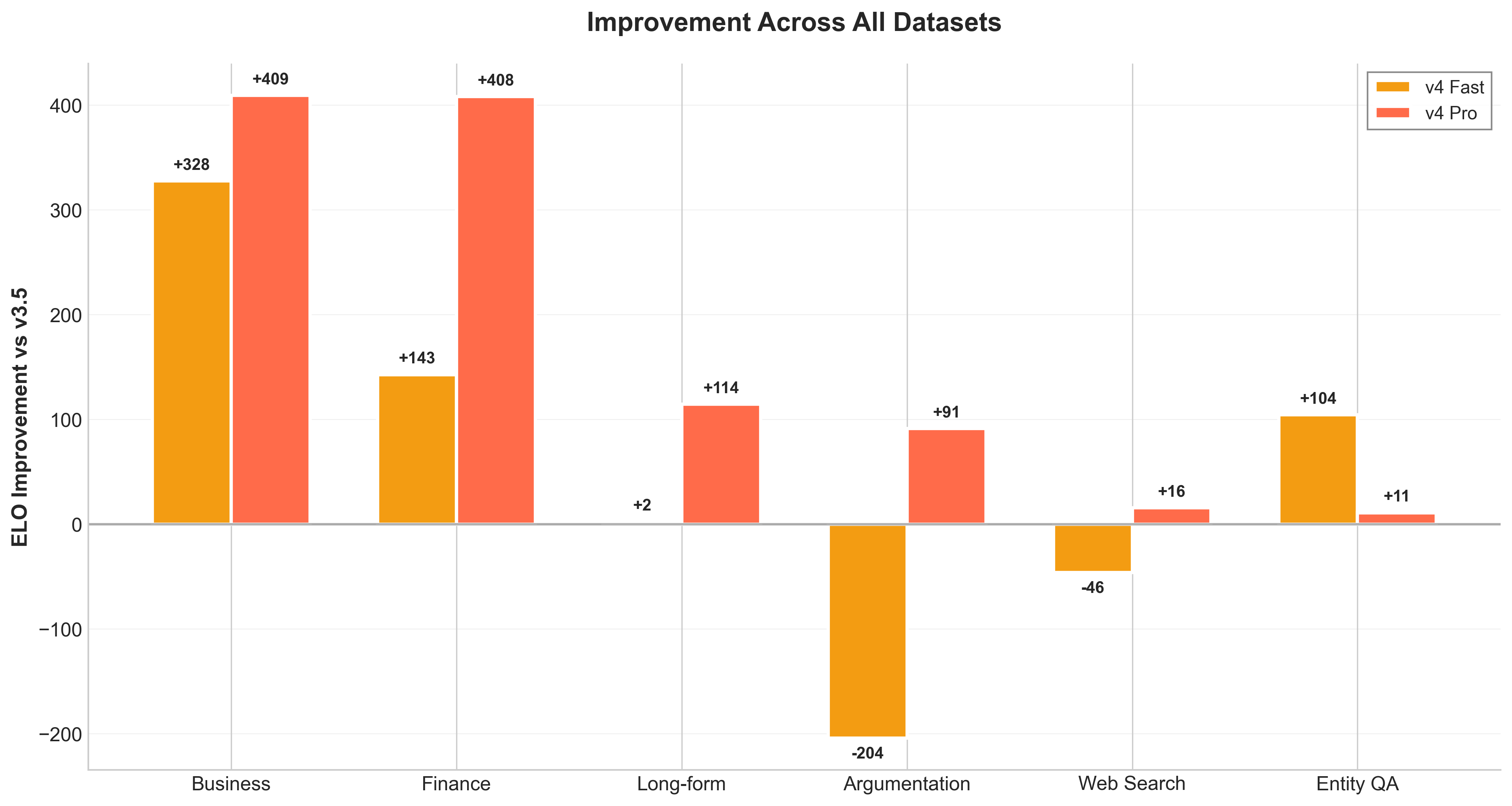
The size of the gain varies:
- on enterprise-style tasks, the jump is large
- on entity-focused workloads, the improvement is modest but still positive
In practice, if you’re already using v3.5, you can swap it for Rerank 4 Pro and expect better ranking quality across all the workloads we tested.
For Rerank 4 Fast, the picture is different: it improves on business, finance, and entity-heavy queries, but does worse than v3.5 on argumentation-heavy and web-style QA datasets. That makes Fast a good fit for enterprise-heavy workloads, but less of a general-purpose upgrade than Pro.
You lose ~27% of speed for better quality
The one real trade-off we see is latency.
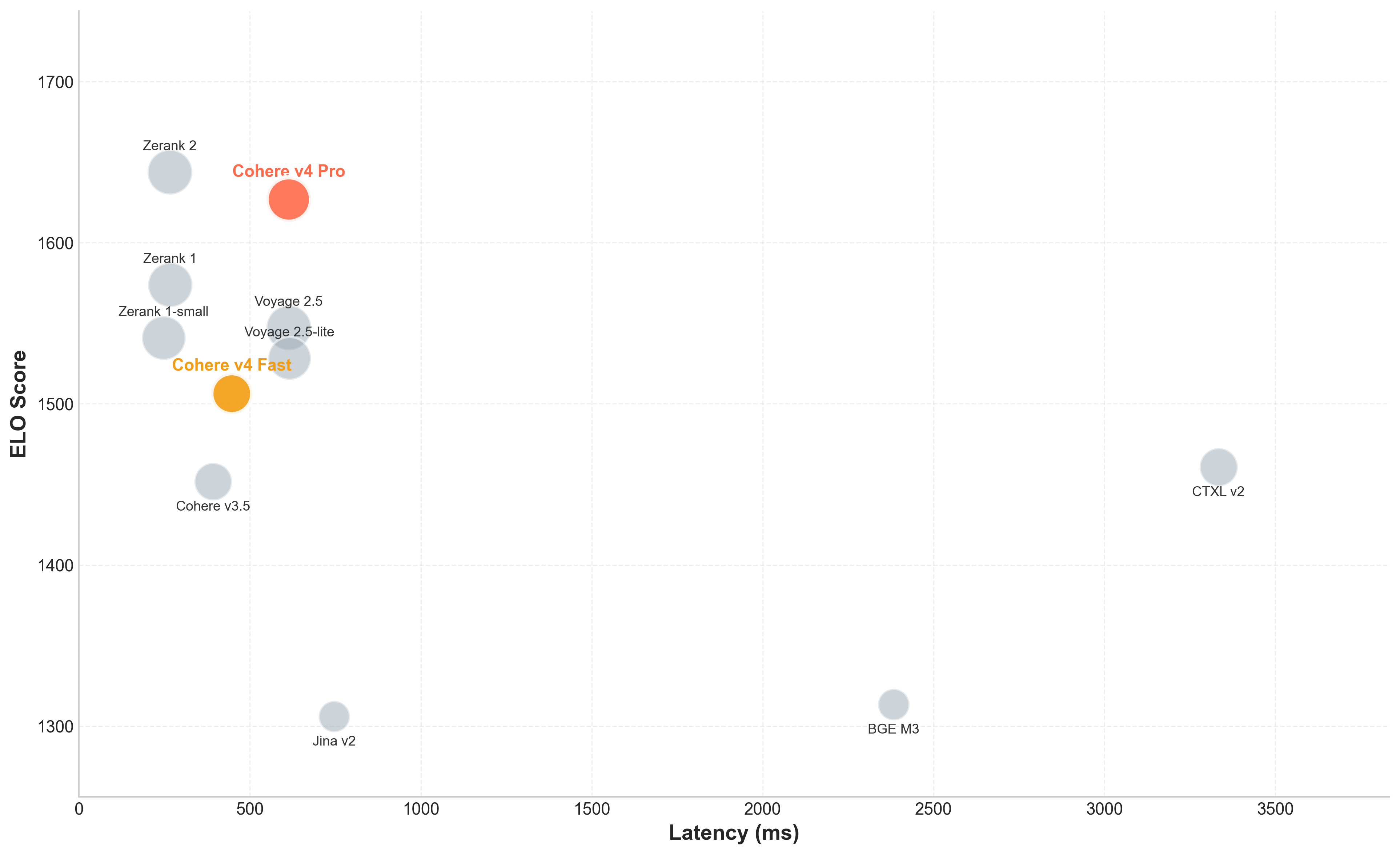
Rerank 4 Pro stays under one second per request in our setup, but it is slower than the fastest model on the leaderboard:
- roughly 60% slower than zerank-2
- about the same speed as Voyage’s premium reranker
Rerank 4 Fast is noticeably quicker than Pro – its latency is about 37% lower (447 ms vs ~614 ms), which works out to roughly a 27% gain in throughput if everything else stays the same. In exchange, it gives up a meaningful amount of ELO compared to Pro.
So the picture is:
- if you want the absolute best speed–quality balance, zerank-2 is still in front
- if sub-second latency is fine and you care more about ranking quality on messy enterprise text, Rerank 4 Pro is a strong choice
- if you’re latency-sensitive and your data is mostly business and finance documents, Rerank 4 Fast can be a reasonable compromise
Conclusion
Taken together, the results are straightforward: Rerank 4 is a real upgrade for Cohere.
- Rerank 4 Pro moves from middle of the pack to reliably near the top, with the biggest gains on business and finance-style text and no regressions across the workloads we tested.
- Rerank 4 Fast gives a smaller but still clear improvement over v3.5, with better latency, and works best when your data is mostly enterprise content rather than mixed web-style queries.
You do pay more in latency for Pro, but the quality jump is clear. Fast sits in the middle: better than v3.5, faster than Pro, but with more trade-offs.
If you want to look closer, you can check our reranker leaderboard and compare Rerank 4 Pro and Rerank 4 Fast against the other models we’ve benchmarked side by side.